Two hundred homes, cast in Nassau.
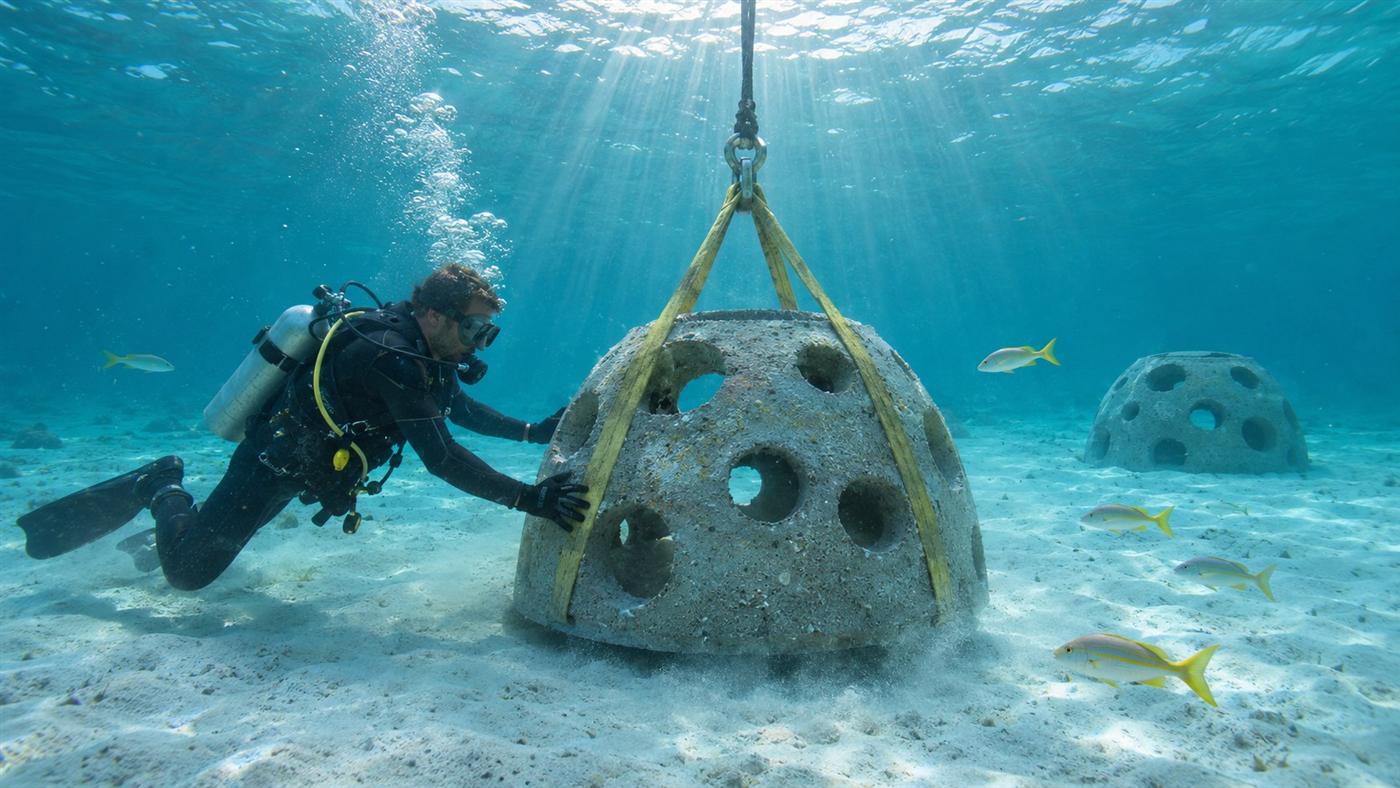
Genuine Reef Ball modules in two sizes, cast in Reef Ball moulds in our own yard, placed by our own crane barge on surveyed sand in ten to twenty metres of water, and counted by divers at three, six and twelve months.
Fish gather on structure. The shelf has almost none.
Most of the bottom around New Providence inside the bank edge is flat sand and fished-out hard ground. A juvenile grouper, snapper or lobster on open sand is food. Give it a hole and it stays, grows and spawns.
Purpose-built modules add hard, hollow, high-relief habitat where there was none, close to the people who fish and dive it. They take pressure off the natural reef. Every diver on a module field or a prepared wreck is a diver not kneeling on live coral, and every fisher working new structure is one less on the reef near town. The dive operators get sites that were not there before, and the real reef gets a rest.
Royal Caribbean has placed Reef Balls at Coco Cay, Baha Mar built an artificial reef, and BREEF's sculpture garden off Clifton showed how fast structure off New Providence is colonised. A programme with proper siting, approvals and monitoring turns those one-offs into a managed network.
Genuine Reef Ball, two sizes.
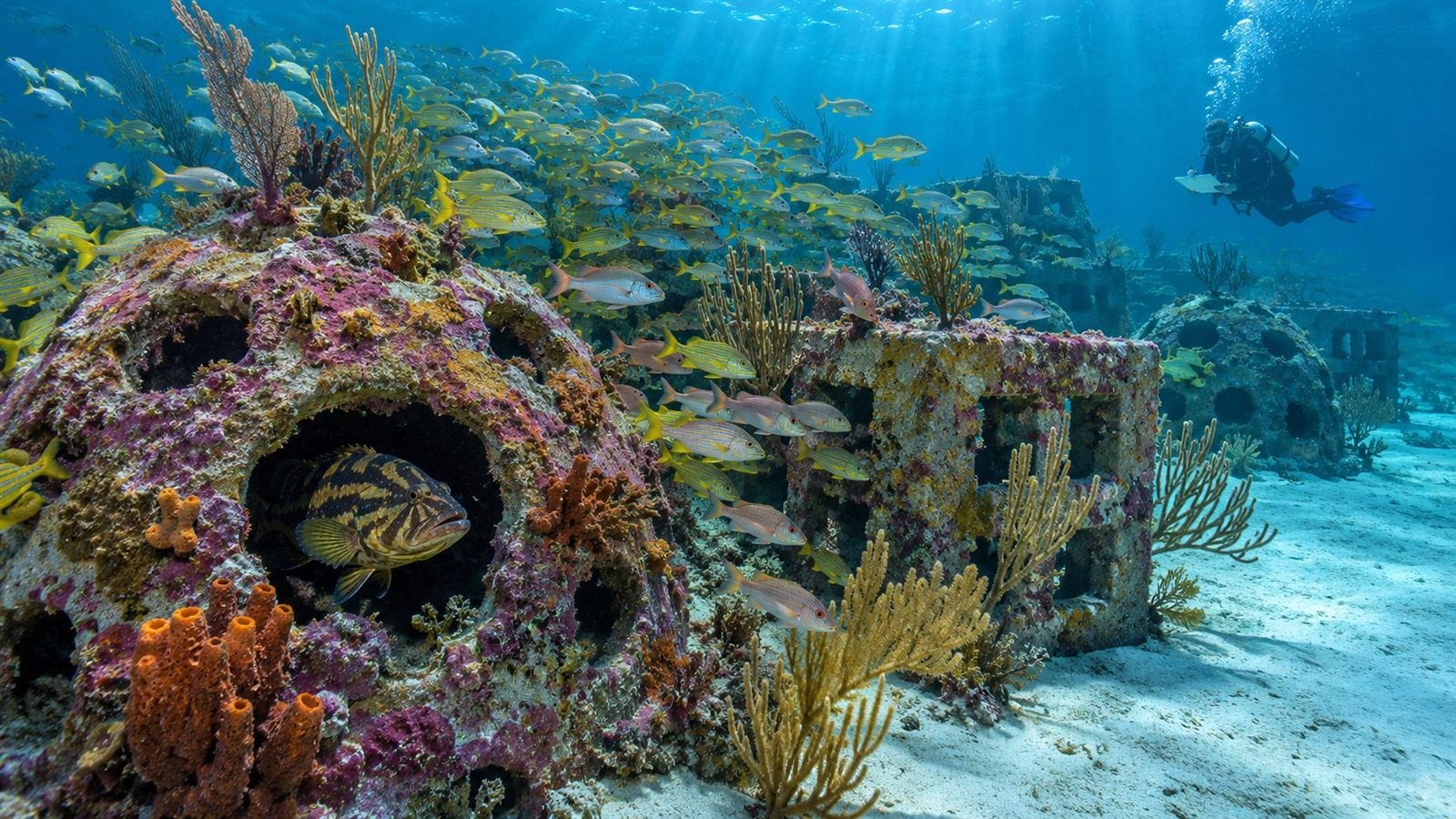
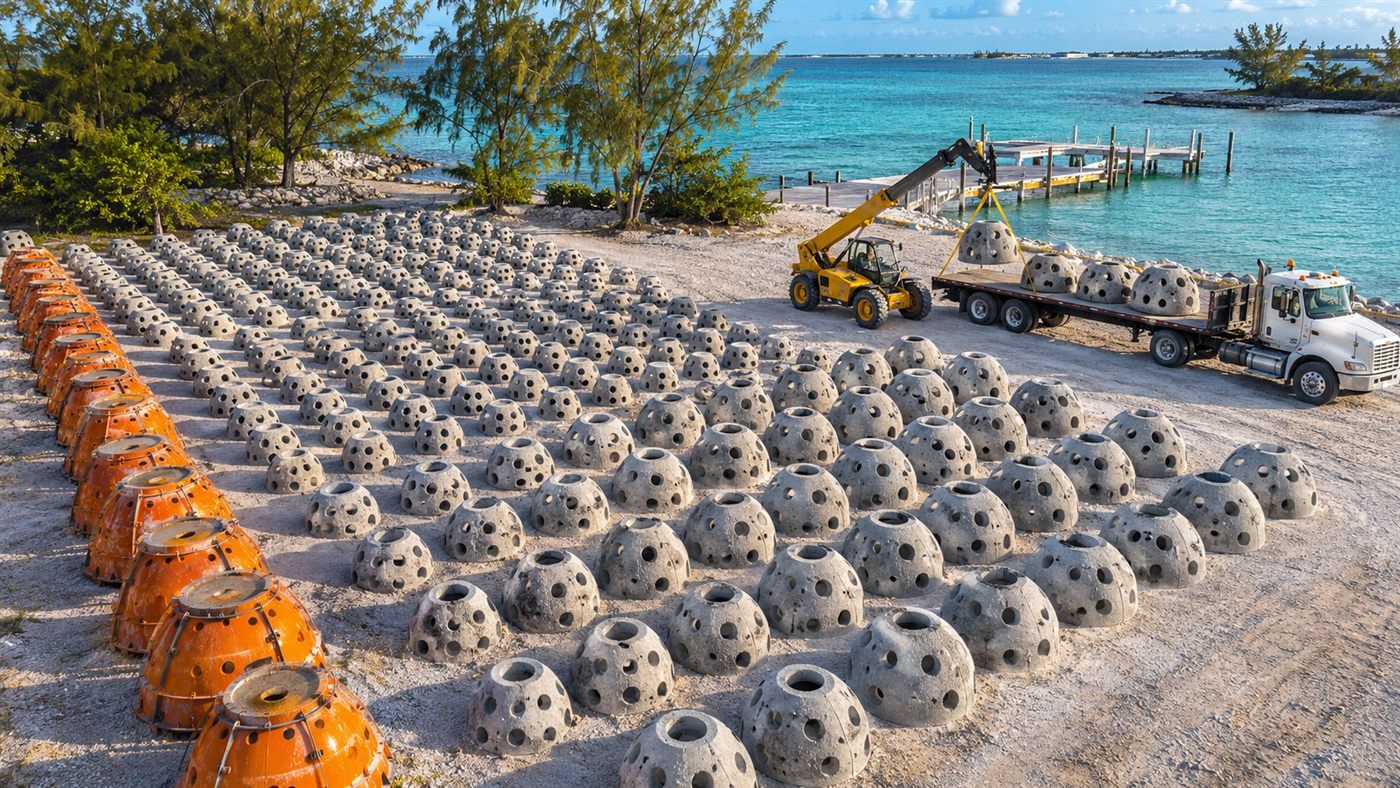
The Reef Ball is a hollow concrete dome with holes of different sizes, a rough textured skin and a pH-neutral surface, designed in 1993 and used in more than sixty countries since. We cast them in moulds from the Reef Ball Foundation's producer, with the Foundation's tool kit and training, so the modules carry a name the dive and science community knows and the design record that goes with it.
| Module | Size | Weight | Role in the cluster |
|---|---|---|---|
| Ultra Ball | about 6 ft wide, 4.5 ft high (1.8 × 1.4 m) | 4,000 to 6,000 lb | The structure of each cluster: big holes for grouper and lobster, overhangs for schooling fish |
| Pallet Ball | about 4 ft wide, 3 ft high (1.2 × 0.9 m) | 1,500 to 2,200 lb | Set between the Ultras: small holes for juveniles, more edge, reads as a reef rather than a row of identical units |
The concrete
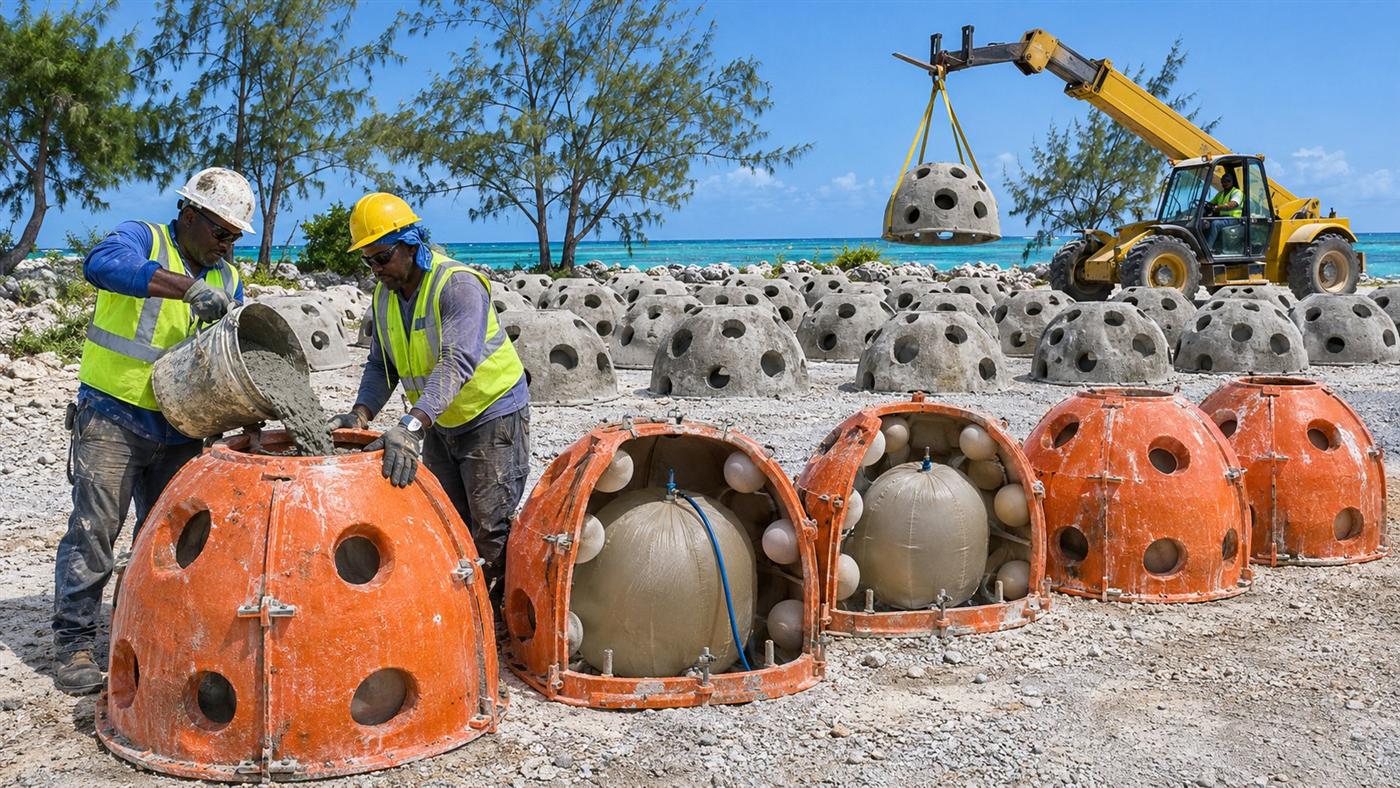
A 6,000 psi marine mix with microsilica for density and a pH-neutral admixture so coralline algae and coral larvae settle on it from the first weeks. The surface is sugar-washed for texture. Each module has a cast-in lifting loop and a cast date.
The yard
Six Reef Ball moulds in rotation at the Hammerhead yard: pour in the morning, demould the next day, cure seven days under water spray, stack, load. Six casts a day gives 200 modules in about seven weeks, with the first hundred ready for the barge by month three.
Sand, not coral. Close, not crowded.
A reef site has to help the fish and the users without touching anything that is already alive. These are the rules every candidate site is tested against before it goes to the agencies.
- Bottom: sand or rubble with no live coral, seagrass or hard-bottom community under the footprint, confirmed by side-scan and dive survey.
- Depth: 40 to 80 ft for module sites, so divers and snorkellers can use them and storm surge cannot move them; 70 to 130 ft for vessels.
- Clear of: shipping lanes, anchorages, cable routes, the AUTEC range and marine protected areas.
- Within reach: under an hour by small boat from Nassau harbour or the agreed Family Island port, so the people who fish and dive it actually can.
- Layout: clusters of 10 to 15 modules with sand channels between. Edge habitat, not a pile.
- Record: every module GPS-fixed as it is placed; as-built chart lodged with the Department of Marine Resources and the Port Department.
Our barge, our divers, one module at a time.
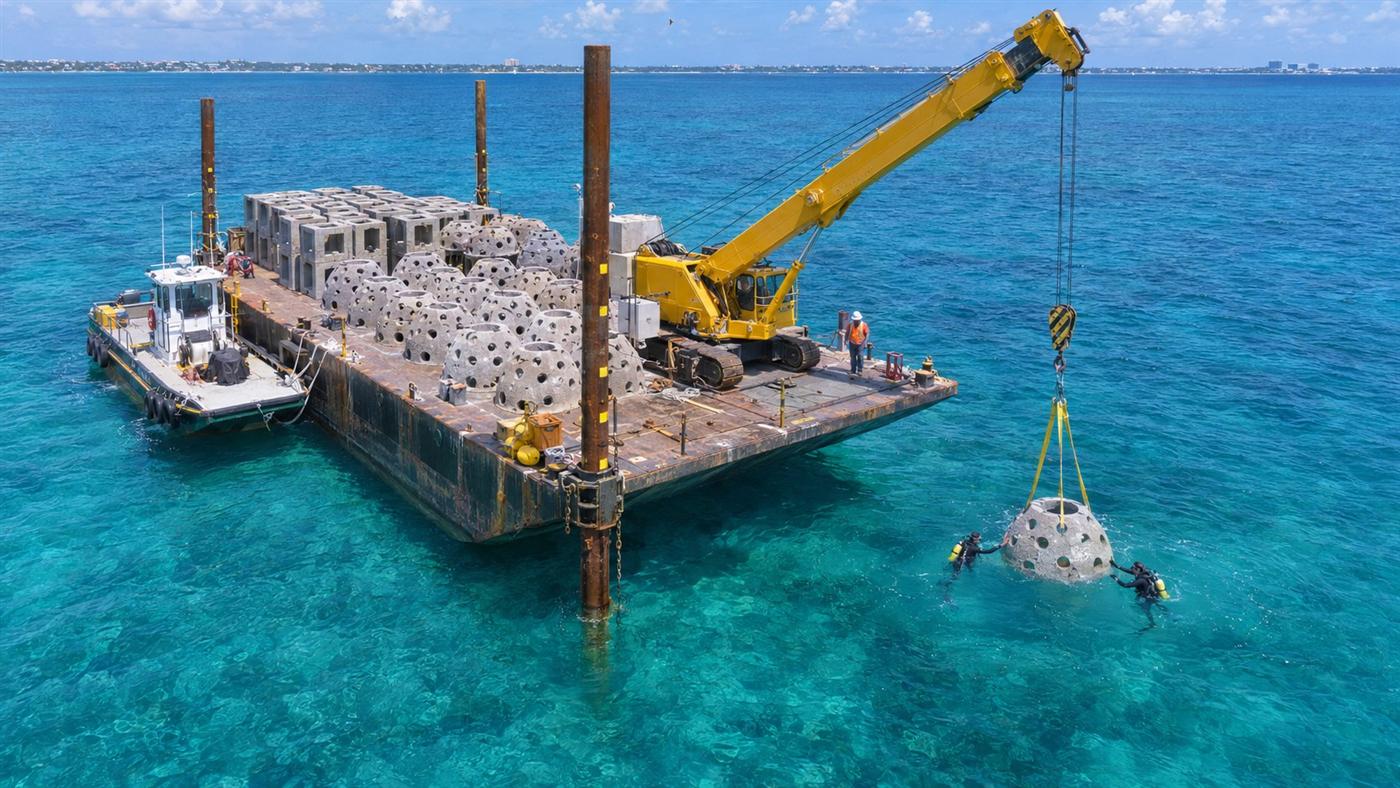
Modules are trucked to the dock and loaded onto Hammerhead's crane spud barge, twelve to sixteen at a time. On site the barge spuds down over the cluster, the crane lowers each module on a strop, and two divers guide it onto the sand, check it is level and un-hook it. The deck crew logs the GPS fix. A good day places thirty to forty modules; a site takes a week.
Nothing is dropped. Nothing is placed on anything living. The first fish, grunts and juvenile snapper, are usually inside before the barge leaves.
Weeks for algae, months for sponge, years for coral.
The sea does most of the work. The programme makes sure somebody is counting.
Fish arrive
Grunts, juvenile snapper and damselfish move in within hours. Divers photograph every cluster for the baseline.
Biofilm and algae
The pH-neutral surface greens over. Grazers follow.
First count
Divers count fish by species and size on fixed transects, with BAMSI and University of The Bahamas students on the boat.
Sponge, soft coral, lobster
Encrusting sponge and soft corals on the shaded faces; lobster in the big holes; the first hard-coral recruits on the textured skin. Counts at six and twelve months; handover of positions, survey record and baseline data to the Department of Marine Resources.
A reef
Hard coral colonies on every module, resident grouper, a snorkel and dive site the operators sell.
The concrete disappears
With restoration on top, the modules are under coral and the site is a reef in its own right.
Structure first. Then the coral has somewhere to go.
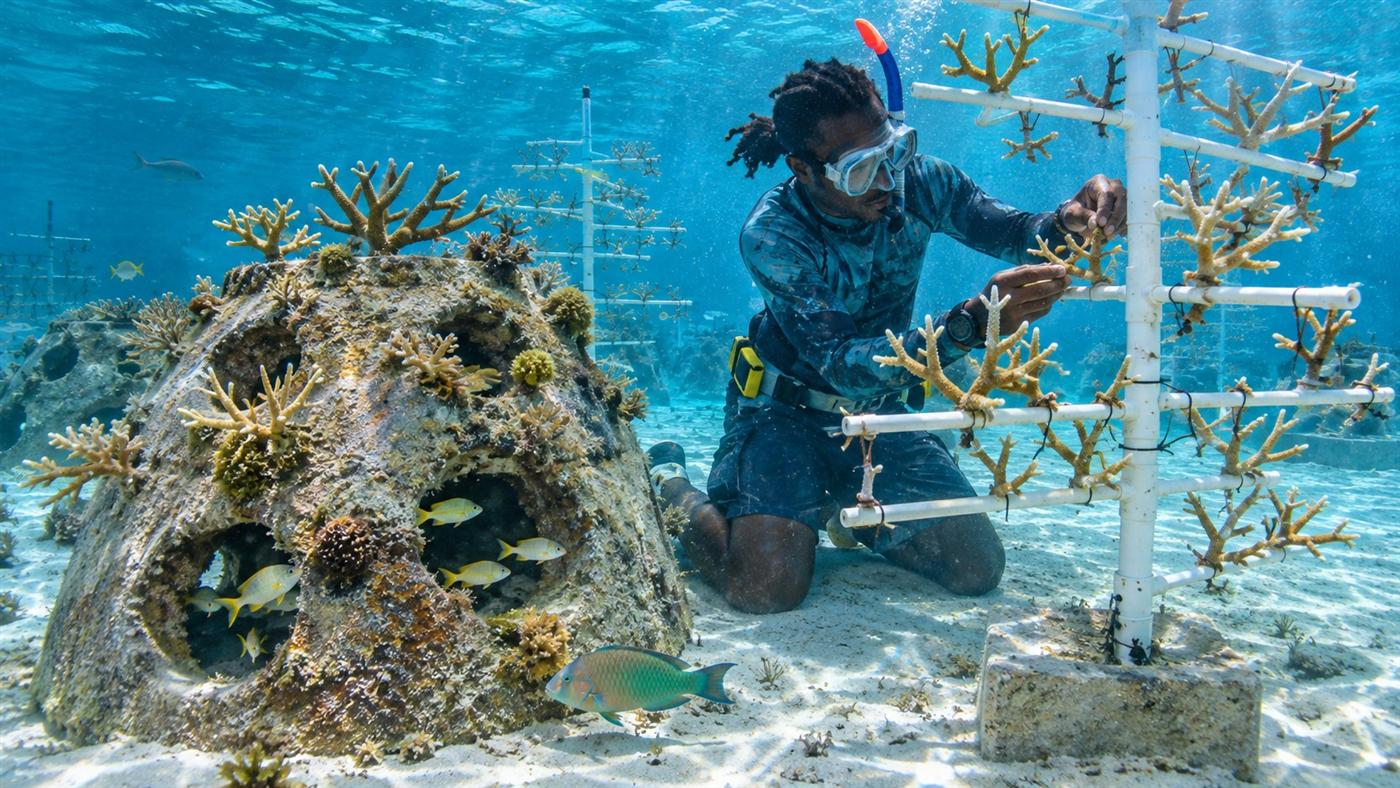
Modules are cast with plug holes. Nursery-grown fragments are fixed into them by our divers with stock from the groups already doing this work in The Bahamas: the Perry Institute's Reef Rescue Network, the Bahamas Coral Innovation Hub at Cape Eleuthera, Coral Vita in Freeport and BREEF.
Staghorn and elkhorn grow fast on tree frames in a nursery beside the modules and are out-planted in bunches. Brain, star and boulder corals grow slowly, so they are cut into microfragments the size of a fingernail, which grow many times faster than a whole colony, then placed in groups that fuse back into one. That is how Mote Marine and Coral Vita restore the slow species, and it is what turns a module field into a reef inside a decade.
Phase 1 carries the plug holes and the baseline. The out-planting is an option per module that any partner, sponsor or Government programme can take up.
Things people ask about the modules.
Why Reef Balls and not something you design yourselves?
Thirty years of data, a known design the agencies and the science groups recognise, moulds that make a consistent module every day, and a name the dive community already trusts. The Foundation's mould comes with its tool kit and training.
Will they move in a hurricane?
A 4,000 to 6,000 lb dome with a low centre of gravity, set in 40 to 80 ft, stays put in the storms the Bahamas gets. Reef Balls in Florida and the Caribbean have sat through major hurricanes. Shallower than 40 ft we do not place them.
Do they harm the seabed?
They go only on bare sand or rubble, confirmed by survey, never on coral or seagrass. Concrete with a pH-neutral surface is inert in seawater.
Can people fish and dive them?
Yes. That is the point. Positions are published, mooring buoys are set so boats tie up instead of anchoring, and the fishers and dive operators are in the site-selection workshops.
How many modules make a difference?
A cluster of 10 to 15 holds fish from day one. A site of 100 in five clusters is a reef the operators will put on the schedule. Two sites is the pilot; the schedule of rates lets Government add sites island by island.
Who owns and maintains them?
The Government of The Bahamas. There is nothing to maintain on a module. The monitoring is the maintenance: counts at three, six and twelve months, then quarterly, with the data handed to the Department of Marine Resources.
A reef to build, or a site to suggest?
Resorts, private islands, co-ops and dive operators all have a view on where the next one should go.